Cells on Asymmetric Patterns
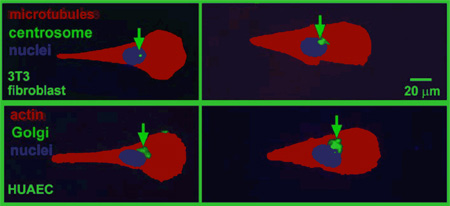
Patterned surfaces confine mammalian cells to asymmetric shapes, which can impose directionality on cell movement and organelle placement. Self-assembled monolayers on gold were used to generate surfaces with teardrop-shaped hydrophobic regions to which single cells adhere. The cells adopted their shape: A wide, blunt end and a sharp, narrow tip. When the cells are released from the surface with a single pulse of current, they moved freely over the surface. However, the initial direction of motion was towards the blunt end in at least 80% of the cells. In NIH 3T3 fibroblast cells confined to asymmetric patterns, the centrosomes positioned themselves near the blunt end of the teardrop-shape (top two figures). In human umbilical artery endothelial cells (bottom two figures), the Golgi bodies localized near the blunt end. Both results held for over 80% of cells studied.
Harvard MRSEC (DMR-0820484)
