Fundamental Structural Rearrangements
in a Flowing Glass
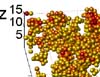
A fundamental property of all glasses is that they flow, albeit at very long time scales if they are far from the glass transition. Such flow necessarily entails structural rearrangements of the constituent particles. Despite their importance in our understanding of the behavior of glasses, such rearrangements can not be directly observed with traditional glassy materials, and instead can be studied only by computer simulation. Spaepen and Weitz used a colloidal glass, visualized with confocal microscopy, to directly observe these structural rearrangements by subjecting the glass to a slow shear strain to induce flow. They showed that the rearrangement events are highly localized, with a core extending over about three particle radii. The elasticity of the glass causes coupling between events with increasing strain, ultimately leading to a percolating network of rearranging particles. The figure isolates the rearranging particles and shows the development of the network as the strain is increased from ~1% to ~2% to ~3%, going left to right. This highlights the critical role of structural rearrangements in flow of glasses, and illustrates unexpected coupling between them.
Frans Spaepen (Material Science)
David A. Weitz (Physics & Applied Physics)
Harvard MRSEC (DMR-0820484)
