Optimal Vein Density in Artificial and Real Leaves
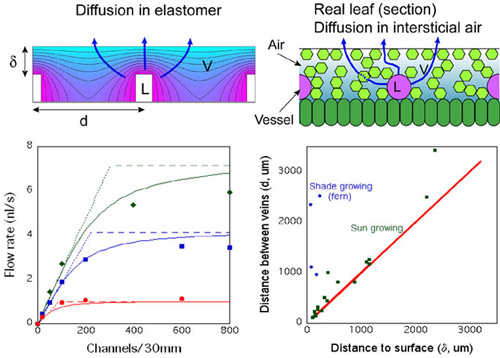
The long evolution of vascular plants has resulted in a tremendous variety of natural networks responsible for the evaporatively driven transport of water. Nevertheless, little is known about the physical principles that constrain the vascular architecture of leaves. Inspired by plant leaves, Zwieniecki, Holbrook, Mahadevan and Weitz used microfluidic devices consisting of a simple parallel channel network in a polymeric material layer, permeable to water, to study the mechanisms of and the limits to evaporation driven flow. The flow rate through the biomimetic leaves increases linearly with channel density (1/d) until the distance between channels (d) was comparable to the thickness of the polymer layer (d), above which the flow rate saturated. The same optimization criterion describes the placement of veins within angiosperm leaves. By elucidating the scaling relations for evaporatively driven flow through simple networks this study is relevant to the engineering of evaporation-permeation driven devices, as well as to the understanding of physical constraints on the biological design of leaves.
David A. Weitz (Physics & Applied Physics)
N. Michelle Holbrook (OEB)
Lakshminarayanan Mahadevan (OEB, Physics, SEAS)
M. Zwienicki
Harvard MRSEC (DMR-0820484)
