Combinatorial Nano-Calorimetry on Ti-Ni-Zr
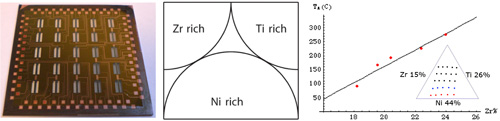
From left to right, the figure above shows a parallel nano-scanning calorimeter (left), a schematic thin film composition distribution (center), and the martensite/austenite transformation temperature as a function of Zr content (right). Taken together these images represent the first combinatorial study (a study of materials properties as a function of composition) using the parallel nano-scanning calorimeter (PnSC). By using an array of sensors and thin-film sample fabrication techniques Vlassak is able to simultaneously create 25 samples of unique composition. Since a single measurement lasts only about 10 milliseconds, the entire library of samples is measured in short order. Vlassak's group used the shape memory alloy Ti-Ni-Zr as a case study to demonstrate the PnSC. They have also used the PnSC to crystallize the amorphous as-deposited ~300 nm films and to detect the martensite-austenite phase transformation responsible for the shape memory effect. As expected the phase transformation temperature increases with increasing Zr content.
David A. Weitz (Physics & Applied Physics)
Cynthia M. Friend (SEAS)
Joost J. Vlassak (Material Science & Mechanical Engineering), and
Patrick J. McCluskey
Harvard MRSEC (DMR-0820484)
