The Physics of a Squeak
High-speed imaging shows how rubber sneaker squeaks arise from supersonic detachment pulses
By Anne J. Manning
February 25, 2026
Key Takeaways
- Squeaks from soft-on-rigid interfaces, like shoes on a smooth floor, are driven by opening slip pulses that rapidly detach and reattach the interface at near-supersonic speeds. The audible pitch is determined by how frequently these pulses repeat.
- Tread patterns act as waveguides, trapping these pulses into a regular, periodic cycle. This geometric confinement produces a clear, well-defined tonal frequency.
- The rupture dynamics of these pulses share key features with fracture fronts observed in tectonic faults, offering a surprising new model for studying earthquake mechanics.
Basketball shoes on a gym floor, bicycle brakes in need of a tune-up, or the squeal of tires are everyday examples of squeaking sounds. Ever wonder why that sound occurs?
Such sounds have long been attributed to stick-slip friction, or a cycle of intermittent sticking and sliding between surfaces. While this framework explains many rigid-on-rigid systems such as door hinges, it does not fully capture the physics of soft-on-rigid interfaces, like shoes on a floor.
To shed light on this little-understood physical process, researchers at the Harvard John A. Paulson School of Engineering and Applied Sciences (SEAS), in collaboration with the University of Nottingham and the French National Center for Scientific Research, used high-speed imaging to investigate the dynamics of soft solids sliding rapidly on rigid substrates. In a study published in Nature  , the team led by first author Adel Djellouli, a postdoctoral fellow in the lab of Katia Bertoldi, the William and Ami Kuan Danoff Professor of Applied Mechanics at SEAS, reports that squeaking emerges from a previously unseen mechanism.
"This project started with a simple question: why do basketball shoes squeak?" said Djellouli. "We combined total internal reflection imaging with cameras capturing up to one million frames per second to visualize the evolving contact between rubber and glass. To drive sliding, we adapted a configuration conceptually similar to Leonardo da Vinci's friction experiments from the 15th century."
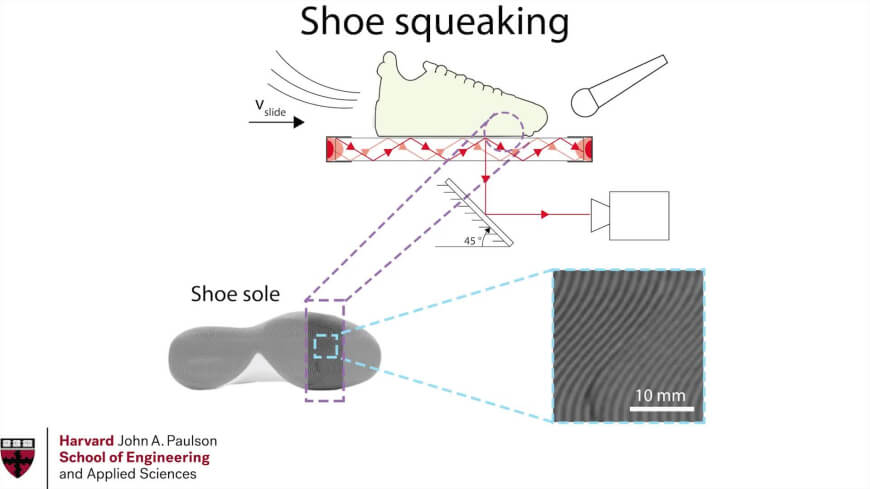
The team's discoveries could surface new ways to engineer and control advanced materials. "Tuning frictional behavior on the fly has been a long-standing engineering dream," Bertoldi said. "This new insight into how surface geometry governs slip pulses paves the way for tunable frictional metamaterials that can transition from low-friction to high-grip states on demand."
Using high-speed optical imaging and synchronized audio measurements, the researchers directly visualized the contact interface between soft rubber and rigid glass. They discovered that sliding does not proceed uniformly. Instead, motion localizes into what they observed as supersonic opening slip pulses: rapid, wrinkle-like detachment fronts that propagate along the interface at high speeds.
They discovered that the audible squeak is not produced by random stick-slip events, as conventional wisdom might suggest. Rather, the squeaking sound frequency is set by the repetition rate of these propagating pulses. Beyond the sound, the study found that these opening slip pulses significantly impact the overall frictional resistance.
In another surprising twist, the high-speed images revealed an unexpected phenomenon that accompanied the squeak: lightning. Lab experiments showed that in some instances, the slip pulses are triggered by triboelectric discharges—miniature lightning bolts caused by the friction of the rubber.
Geometry also plays a decisive role in sound generation, the researchers found. During lab experiments, when rubber blocks with flat surfaces were slid along glass, the pulses were complex and irregular, resulting in broadband noise that resembled a rushing or swooshing sound. But thin ridges dramatically altered the dynamics: the pulses became confined and periodic, producing more focused pitches.
This geometric confinement forces the pulse repetition rate to lock into a characteristic frequency determined by the system dimensions. The researchers observed a scaling relationship, in which the squeak frequency depends primarily on the block height—a relationship so precise, that the researchers were able to design rubber blocks of varying heights to play the Star Wars theme song by hand.
"We were surprised that tiny surface features could so strongly reorganize frictional motion," said co-author Gabriele Albertini, of University of Nottingham. "These results challenge the assumption that friction can be fully captured by simplified one-dimensional models and highlight the critical role of interface dimensionality."
The implications extend beyond squeaky shoes. The physics governing these slip pulses, specifically how two surfaces move relative to each other, mirror earthquake dynamics, where ruptures and slip pulses propagate along tectonic faults at extremely high speeds, approaching and sometimes exceeding the speed of sound.
"These results bridge two fields that are traditionally disconnected: the tribology of soft materials and the dynamics of earthquakes," said co-author Shmuel Rubinstein, professor of physics at Hebrew University and visiting professor at SEAS. "Soft friction is usually considered slow, yet we show that the squeak of a sneaker can propagate as fast as, or even faster than, the rupture of a geological fault, and that their physics is strikingly similar."
Authorship, funding, disclosures, ownership
The research was carried out through an international collaboration among Harvard University (USA), CNRS/Université du Mans (France), the Hebrew University of Jerusalem (Israel), and the University of Nottingham (UK), supported by the U.S. National Science Foundation through the Harvard MRSEC DMR-2011754; and an NSF Graduate Research Fellowship, the Simons Collaboration on Extreme Wave Phenomena Based on Symmetries, BASF, and the Swiss National Science Foundation.
