Colliding Smoke Rings: Visualizing Turbulence at New Length Scales
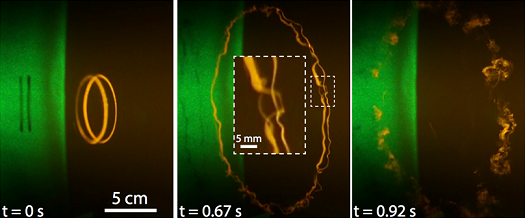
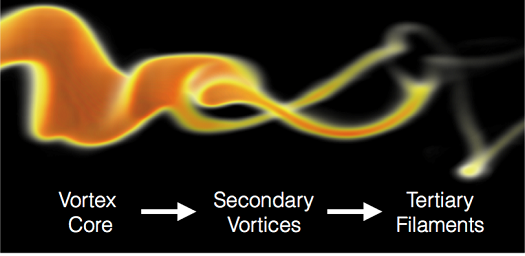
When two smoke rings collide head-on, the initially smoothly flowing structures (a) rapidly become unstable. They develop complex three-dimensional dynamics that result in the (b) vortex cores breaking down into (c) finer-scale "turbulent cloud." Through the use of high-speed, scanning laser sheet microscopy, Rubinstein and Brenner of the Harvard MRSEC reconstruct the intricate, three-dimensional structures (bottom). They observe that the breakdown of the vortex cores is caused by the local flattening of the cores into vortex sheets, which themselves break in the same manner into even smaller tertiary vortex filaments. This iterative cascade is indicative of a possible mechanism by which kinetic energy is conveyed to smaller length scales in turbulent flows, as noted by recent theoretical predictions by Brenner.
Michael P. Brenner (Applied Math), Caitlyn Cook (LLNL), and Ronald Pindak (BNL)
2017-2018 Harvard MRSEC (DMR-1420570)
