Enriching Teacher Professional Development and K12 Education through RET
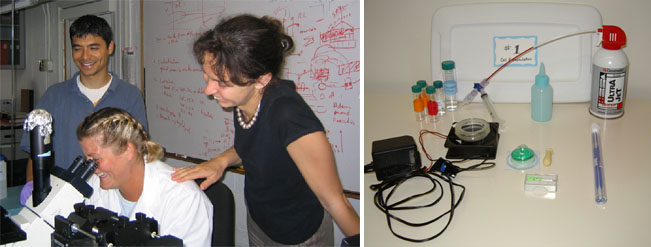
Biology teacher Rebekah Ravgiala worked in the laboratory of Professor David Weitz in summer 2004 to develop a classroom activity that emphasized connections between biology, physics, and engineering. Drawing upon the microfluidics expertise in the Weitz group, she worked with graduate student Andy Utada and postdoc Dr. Elise Lorenceau to develop an E. coli cell encapsulation module for the high school classroom.
While investigating the feasibility of adapting existing capillary-based microfluidics devices for the high school setting, Rebekah identified several barriers to implementation in the classroom, such as durability and expense. The research team solved these problems by spraying a bacteria-containing hydrogel into a continuous phase in a spinning Petri dish. The relatively inexpensive apparatus developed consisted of accessible components such as a variable speed computer fan, computer duster, and various valves and tubing.
Rebekah presented this work at the 2004 MRS meeting, and won a "Ribbon Award Winner" for her paper, "Employing Microfluidics in the Demonstration of Cell Encapsulation," in MRS Online Proceedings Library edited by S. Baker, F. Goodchild, W. Crone, and S. Rosevear (Mater. Res. Soc. Symp. Proc. 861E, Warrendale, PA, 2005), PP0.1
David A. Weitz (Physics & Applied Physics)
Harvard MRSEC (DMR-0820484)
