Shear Transformation Zones in Colloidal Glasses
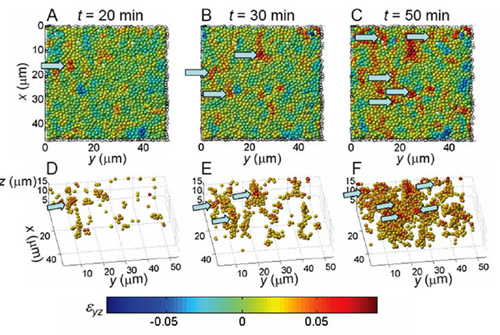
Direct, real-space 3-D observation of shear transformation zones in a glass.
A colloidal glass is used to mimic the behavior of atomic and molecular glasses. Upon application of an external shear strain, there are highly localized regions of much higher strain, where particles move irreversibly. These are illustrated in the Figure, where the high-strain regions are colored red. Particle motion here is irreversible. Application of larger strains leads to a network of shear transformation zones whose formation are coupled through the elasticity of the glass. This is the first direct observation of shear transformation zones.
Frans Spaepen (Material Science)
David A. Weitz (Physics & Applied Physics)
Harvard MRSEC (DMR-0820484)
