Probing Neuronal Origin of Behavior in C. elegans
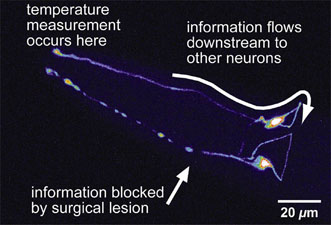
Mazur and Samuels developed a laser technique to perform nanosurgery to make tiny cuts in a temperature-sensing cell in the worm C. elegans (see Figure). These cuts separate sensors in the nose from the rest of the brain of the worm, so the worm cannot measure temperature. As a result, they notice a significant change in the behavior of the worm: worms at a hot spot do not try to move to a cooler location. They can use this technique to pinpoint with extreme accuracy what parts of certain brain cells perform which functions. A deeper understanding of the brain of C. elegans, which only has 302 neurons, will assist scientists in unlocking the secrets of the human brain.
Samuel Chung, Aravinthan Samuel, Eric Mazur, and Jonathan Kamler
Harvard MRSEC (DMR-0820484)
