Squeaking at Soft-Rigid Frictional Interfaces
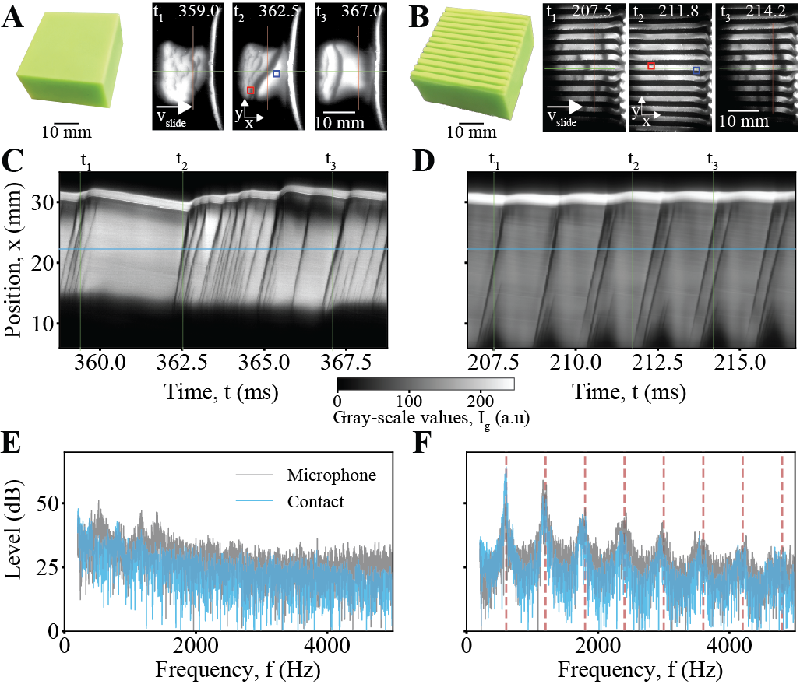

Squeaking often occurs when two bodies slide against each other, yet its mechanisms are not fully understood, especially at soft–rigid interfaces. Bertoldi, Weitz, and Rubinstein used high-speed imaging and acoustic analysis to reveal that, at squeaking velocities, opening pulses propagate at approximately the shear wave speed of the soft material and mediate local slip. For flat interfaces, these pulses are irregular and produce broadband sound emissions. However, adding thin surface ridges confines pulse propagation, stabilizing it into coherent, periodic pulse trains that generate tonal squeaking at a frequency set by the first shear mode of the block, demonstrating a structure-driven mechanism for controlling frictional rupture.
Article:
The Physics of a Squeak, High-speed imaging shows how rubber sneaker squeaks arise from supersonic detachment pulses
Publication:
Djellouli, A., G. Albertini, J. Wilt, V. Tournat, D. Weitz, S. Rubinstein, and K. Bertoldi, "Squeaking at soft–rigid frictional interfaces," Nature 650 (8103), 891-897 (2026). 

Katia Bertoldi (Mechanical Engineering), David A. Weitz (Physics & Applied Physics), and Shmuel Rubinstein (Hebrew University)
2025-2026 Harvard MRSEC (DMR-2011754)
