Architected Liquid Crystal Elastomer Lattices with Programmable Energy Absorption
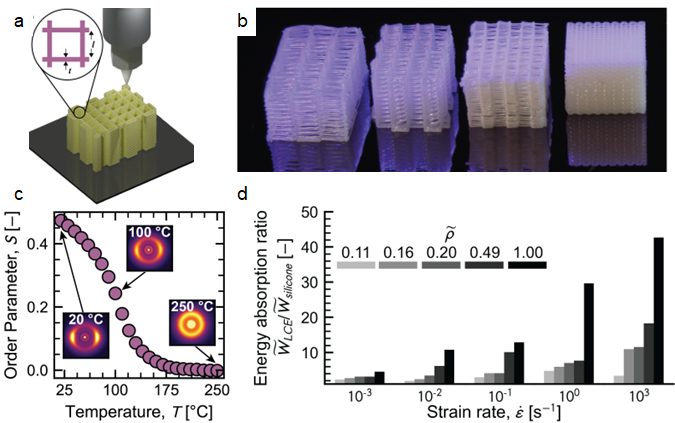
Soft, energy absorbing materials are widely used in protective gear, biomedical devices, and robotics. Lewis and her collaborators at Lawrence Livermore National Laboratory (LLNL), demonstrated that printed and aligned liquid crystal elastomer (LCE) lattices exhibit superior energy absorption compared to silicone elastomers. Both aligned LCE and silicone (non-mesogenic controls) lattices were printed in woodpile geometries of varying density and their mechanical properties were measured over a wide range of strain rates (10-3 to 103 s-1). Aligned LCE lattices exhibited superior energy absorption compared to controls. This trend was most pronounced at the highest strain rate (103 s-1), in which aligned LCE lattices (𝜌 = 0.49) exhibited an 18-fold increase in energy absorption compared to silicone lattices at the same relative density.
Publication:
Telles, R., J.A. Mancini, J.L. Barrera, M. Simoes, D.H. Porcincula, A. Bischoff, D.J. Roach, S.C. Leguizamon, E. Lee, C.C. Cook, and J.A. Lewis, "Architected liquid crystal elastomer lattices with programmable energy absorption," Advanced Materials 37 (35), 2420048 (2025). 

Jennifer A. Lewis (Material Science & Bioengineering), Caitlyn Cook (LLNL), and
Elaine Lee (LLNL)
2025-2026 Harvard MRSEC (DMR-2011754)
