Towards Differentiation in Untethered Microactuators: A Soft Fabrication Strategy
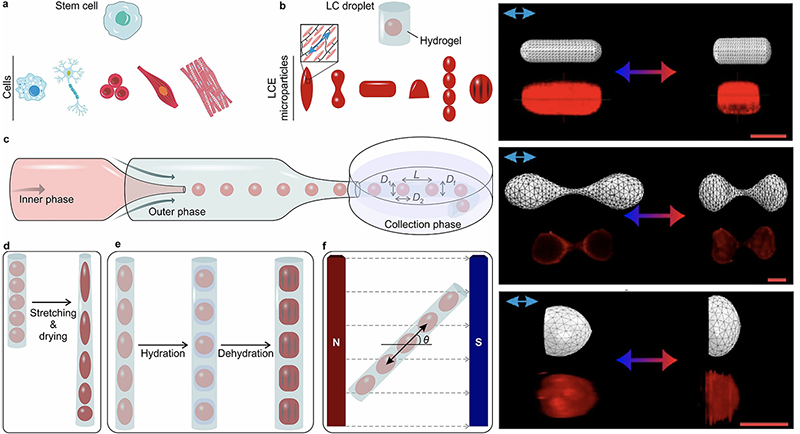
Aizenberg, Bertoldi, and Weitz fabricated hydrogel-liquid crystal micro-actuators with distinct shapes, surface textures, and actuation modes. Mechanical and chemical stimuli are used to deform and transmit geometrical and textural changes to embedded droplets prior to polymerization. By fine-tuning of their assembly, droplets can transform into a diverse array of microparticle geometries, including spindles, rods, pancakes, dumbbells, and pyramids. By rapidly dehydrating and polymerizing the LC-filled droplets in an applied magnetic field, their 3D mesogenic orientation can be controlled resulting in thermally induced shape morphing responses, which are validated via finite element analysis.
Publication:
Wilborn, A.M., H. Almohammadi, P. Qu, Y. Wang, Y. Yang, R. Kay, D. Kim, K. Bertoldi, D.A. Weitz, and J. Aizenberg, "Towards differentiation in untethered microactuators: A soft fabrication strategy," Advanced Materials 37 (51), 2507273 (2025). 

Joanna Aizenberg (Chemistry and Material Science), Katia Bertoldi (Mechanical Engineering), and
David A. Weitz (Physics & Applied Physics)
2025-2026 Harvard MRSEC (DMR-2011754)
